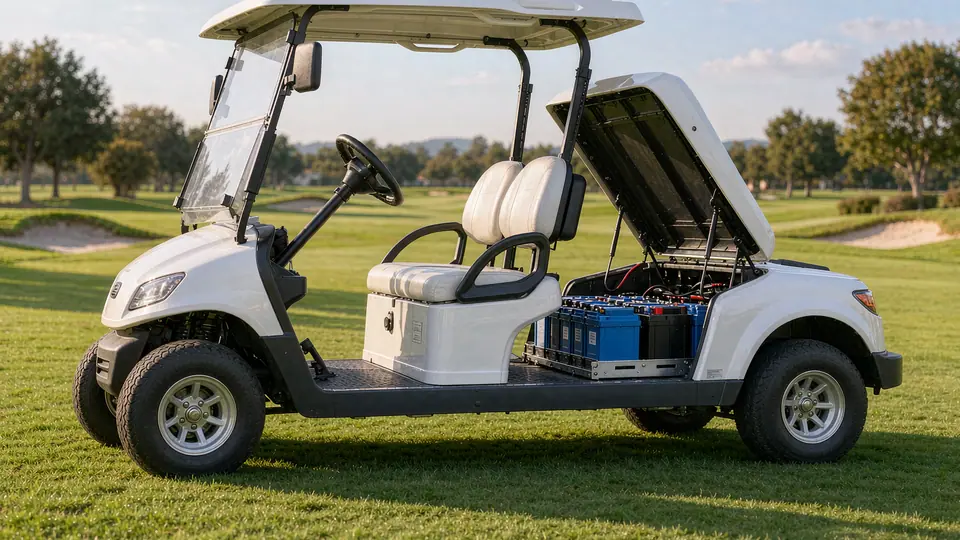
Converting a golf cart from lead-acid to lithium is the single best performance upgrade you can make — and also the one with the most compatibility gotchas. Here is the complete picture.
The Core Decision: 36V or 48V
First, identify what your cart runs. Check the battery count in your tray: six 6V batteries in series = 36V; six 8V or four 12V = 48V. Club Car, EZGO and Yamaha all shipped both configurations depending on year and model.
Now the lithium translation, and this trips people up — with LiFePO4, a "36V" cart usually takes a 12S pack (38.4V nominal, 43.8V full), and a "48V" cart takes a 16S pack (51.2V nominal, 58.4V full):
| Cart platform | Lithium pack | Nominal | Fully charged |
|---|---|---|---|
| 36V | 12S LiFePO₄ | 38.4V | 43.8V |
| 48V | 16S LiFePO₄ | 51.2V | 58.4V |
These sit correctly within each platform's operating window — that is the standard the industry has settled on. Always confirm the pack's nominal and full-charge voltage against your cart's controller spec before buying.
The Weight Story
A stock 48V golf cart carries 300+ lbs of lead-acid. A lithium conversion drops that to about 60–100 lbs, and concentrates the mass low in the battery tray.
What you feel immediately:
- Quicker acceleration (better power-to-weight)
- Less wear on brakes, tires and suspension
- Noticeably more cargo/passenger capacity before hitting limits
Sizing Range: How Far Will You Go?
Lead-acid range fades fast because deep discharge kills them. Lithium delivers nearly its full rating every cycle. Practical field numbers for a 105Ah-class lithium pack on a 48V cart: a full round of 18 holes uses well under 20% of capacity; serious all-day resort/fleet use fits comfortably.
Rule of thumb: one 105Ah 48V lithium pack ≈ your full original 6-battery lead-acid set for range, with headroom to spare.
GC2 Drop-In Fit
Golf carts standardized on the GC2 battery footprint (≈ 26.4 × 18.2 × 24.7 cm) because the tray was literally designed for it. Look for lithium packs built to GC2 dimensions — they bolt into the existing space with OEM hold-downs, no tray fabrication, no modification. Check terminal type too (most conversions use bolt-style posts like M8).
Compatibility Checklist (Do This Before Buying)
- Controller voltage window. Most modern carts' controllers happily accept LiFePO4's flat discharge curve, but a few older 48V controllers trip on low-voltage cut-off setpoints designed for sagging lead-acid. Verify or plan a controller update.
- Charger: non-negotiable swap. Lead-acid chargers (even "smart" ones) use the wrong profile. You need a charger matched to your pack: 12S packs charge to 43.8V; 16S packs to 58.4V (CC/CV). Buy the charger the battery manufacturer recommends — or better, the one sold for that exact pack.
- Series/parallel rules. Follow the pack's stated limits exactly — many packs are "4P max, no series" — and always top-charge batteries to matching voltage before paralleling.
- BMS peak rating vs controller surge. Hills and loaded starts pull momentary peaks. Your pack's BMS should cover it with margin; peak specs must include a time rating (e.g., 500A @ 10s · 1,000A @ 1s).
- Onboard computer (OBC) bypass. Some Club Cars with OBCs need a bypass kit when converting — a $20 part and five minutes, but you want to know before install day.
Cold Weather and Storage
Same lithium rules as everywhere: the BMS must block charging below 0°C; self-heating packs solve winter charging for cold-climate carts. For off-season storage, park at ~50% charge, store above -10°C, and top up every three months.
What About LSVs, UTVs and Utility Carts?
The same logic applies to street-legal neighborhood carts, UTVs and yard machines on 36V/48V platforms — check the controller window, swap the charger, match the tray. (This is also why you should never wire a 24V battery into a golf-cart application: carts are 36V/48V territory only.)
The Payoff
Converted carts routinely run 5+ miles further per charge, charge in a fraction of the time, and shed two-thirds of their battery weight — and with 4,000+ cycles at 80% DOD, the pack will likely outlast the cart's plastics.
Ready to convert? 36V / 48V golf cart lithium batteries (GC2 fit)
Send us your cart's make, model and year — contact us — and we will confirm the exact pack, charger and any bypass parts you need.