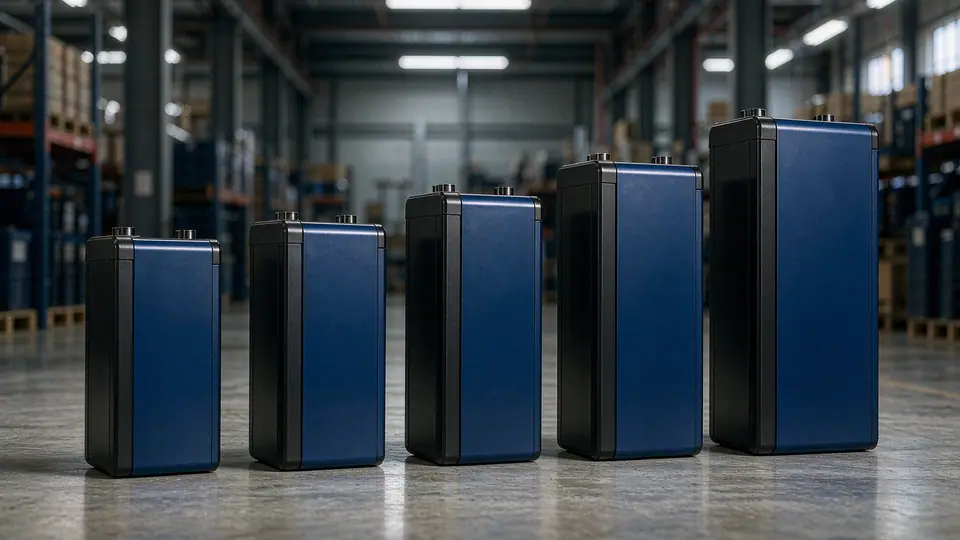
If you've ever tried to replace an RV, boat or golf cart battery, you've run into mysterious labels like "Group 24" or "GC2." Those are BCI Group sizes — North America's standard battery footprint system — and understanding them is the difference between a five-minute drop-in swap and a battery that doesn't fit.
What BCI Group Actually Means
The Battery Council International assigns group numbers to standardized battery dimensions (length × width × height) and terminal layouts. Two batteries with the same group number physically fit the same battery box — regardless of brand, chemistry or capacity.
This is what makes "drop-in replacement" possible: your tray, hold-downs and cables stay put; only the battery changes.
The Groups You'll Actually Meet
| BCI Group | Approx. dimensions (cm) | Where it lives |
|---|---|---|
| U1 | 19.7 × 13.2 × 18.6 | Lawn mowers, small equipment |
| 22NF | 24.0 × 17.5 × 19.0 | Kayaks, small boats |
| Group 24 | 26.0 × 17.3 × 22.5 | RV and marine, compact trays |
| Group 27 | 30.8 × 17.0 × 21.1 | RV and marine, the classic fit |
| Group 31 | 32.9 × 17.3 × 23.9 | Trolling motors, RV house, heavy marine |
| Group 4D | 52.7 × 22.2 × 25.0 | Large RVs, commercial vehicles |
| Group 6D | 52.7 × 25.4 × 26.0 | Large RVs, commercial vehicles, higher capacity |
| Group 8D | 52.7 × 28.3 × 25.0 | 300Ah+ storage banks, commercial trucks |
| GC2 | 26.4 × 18.2 × 24.7 | Golf carts (6V/8V lead-acid replacements) |
Groups 24/27/31 are the workhorses of the RV-marine world, and GC2 owns the golf cart aisle. If you remember four numbers, remember those.
The Three Rules of a Real Drop-In Swap
Rule 1: Match the Group Exactly
A Group 31 battery does not fit a Group 27 tray. One group off means a battery box that won't close, hold-downs that won't reach, or a pack that rattles. Zero tolerance here — measure your tray and confirm the group before ordering.
Rule 2: Check Terminal Position Too
Some groups have reversed terminal variants (positive on left vs right). Cables have fixed lengths; a mirrored terminal layout can leave your positive cable an inch short. Quality listings specify terminal type and position — down to the bolt size (e.g., M8).
Rule 3: Verify Height, Not Just Footprint
Some trays have height constraints (under-seat compartments, enclosed boxes). A battery that matches L×W but stands 2cm taller won't close the lid.
Why Lithium Makes Group Sizes More Interesting
Here's the bonus that surprises first-time lithium buyers: because LiFePO4 stores roughly three times the energy per pound and doesn't need heavy lead plates, a lithium battery in a given group size typically offers far more capacity than the lead-acid it replaces.
- A Group 31 lead-acid: typically 100–110Ah (of which ~50Ah usable)
- A Group 31 LiFePO4: 100–200+Ah (with ~90% usable)
Same tray. Double (or more) the real-world runtime. This is why Group 31 lithium drop-ins are the single hottest category in RV/marine upgrades — and why a smaller Group 24 lithium often outperforms the Group 27 lead-acid it replaces.
The Group Cheat Sheet by Application
- RV house battery (compact Class C/trailer): Group 24 → 27
- RV house battery (most rigs, one battery): Group 31
- Trolling motor (single battery): Group 31 (22NF for kayak setups)
- Golf cart conversion: GC2-sized packs (or a single custom tray pack)
- Big off-grid banks / commercial: Group 4D / Group 8D
- Don't know? Measure your battery box L×W×H in cm, then match the table above.
Before You Order: The 60-Second Fit Check
- Read the group number off your old battery's label (usually molded on top)
- Measure the tray interior in cm — cross-check the table
- Note terminal position and type
- Choose lithium capacity to taste — the group guarantees the fit, the Ah decides your runtime
Find your group: Shop Group 24 / 27 / 31 / GC2 LiFePO4 batteries
Send us a photo of your battery tray and old battery label — contact us — we'll confirm the exact fit.