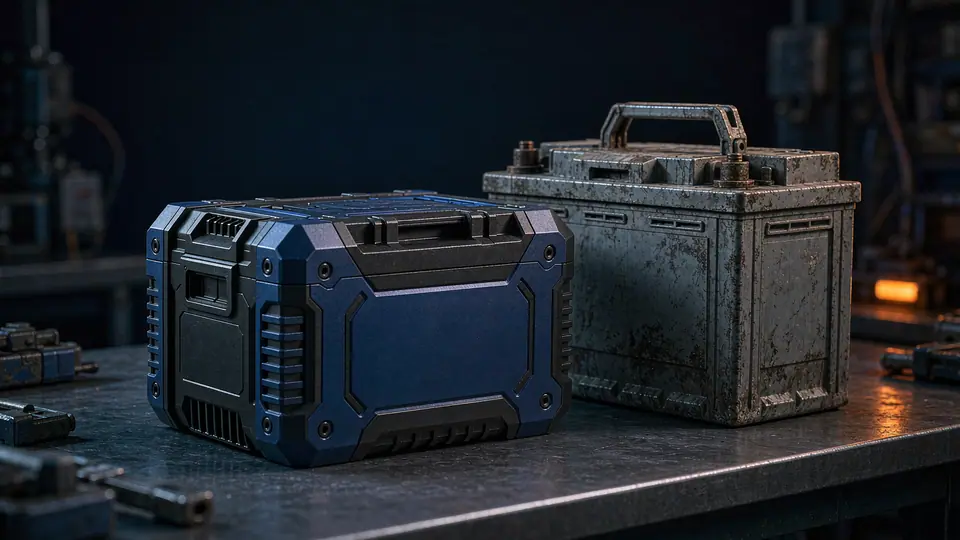
If you own an RV, a boat, a golf cart, or any piece of equipment that runs on lead-acid batteries, you have probably wondered whether upgrading to lithium is worth the money. The short answer: in almost every deep-cycle application, a LiFePO4 (lithium iron phosphate) battery saves you money over time — sometimes a lot of it. Here is the honest, number-by-number breakdown.
Round 1: Lifespan
A typical flooded or AGM lead-acid battery lasts 300–500 cycles when regularly discharged to 50%, which is the depth most manufacturers recommend if you want it to survive.
A quality LiFePO4 battery delivers 4,000+ cycles at 80% depth of discharge — and most of that discharge is usable every single time.
Translated into real life: if you camp or fish every weekend, a lead-acid battery might last 2 seasons. A LiFePO4 battery can last 8–10 years of the same usage. You would replace your lead-acid battery three to five times before one lithium battery retires.
Round 2: Usable Capacity
This is the number most buyers miss. A "100Ah" lead-acid battery gives you about 50 usable amp-hours, because discharging below 50% regularly destroys its lifespan.
A 100Ah LiFePO4 battery gives you 90–100 usable amp-hours, because lithium tolerates deep discharge without damage.
So when comparing price tags, remember: a 100Ah lithium battery does the real work of a 200Ah lead-acid bank. Compare those two prices instead.
Round 3: Weight
LiFePO4 weighs roughly one-third of an equivalent lead-acid battery. A Group 31 lead-acid tips the scale around 60–70 lbs; the lithium equivalent is often under 25 lbs.
For boaters, that means better speed and fuel economy. For RV owners, it means precious payload capacity back. For anyone hauling batteries into a battery compartment, it means no more back injuries.
Round 4: Charging Speed
Lead-acid charges slowly and hates fast charging — push it and it heats, sulfates, and dies early.
LiFePO4 accepts high charge currents happily. With a properly matched charger, you can routinely recharge at 0.5C or higher, reaching 80% in a fraction of the time. If you recharge with solar between fishing spots or at a campsite, you will notice the difference every single day.
One rule that cannot be skipped: lithium requires a lithium-specific charger matched to your battery's voltage. Never use your old lead-acid charger.
Round 5: The 10-Year Total Cost
Let's do the honest math for a typical 12V deep-cycle setup:
| Lead-acid AGM 100Ah | LiFePO4 100Ah | |
|---|---|---|
| Upfront cost | $$ | $$$$ |
| Replacements over 10 years | 3–5 batteries | Usually 1 |
| Usable capacity per battery | ~50Ah | ~100Ah |
| Weight per battery | ~60 lbs | ~20 lbs |
| Maintenance (watering, equalizing) | Regular | None |
When you add up replacement purchases, installation labor, and the frustration of a dead battery on day two of a trip, LiFePO4 is usually the cheaper option per usable amp-hour over its life.
That math is exactly why CBJJ builds what it builds. Every CBJJ LiFePO4 pack ships with Grade-A cells assembled in our own factory in Dongguan, China, a 1-year warranty, UN38.3 transport documentation for every pack, and — for US buyers — a stocking warehouse in Chicago, so replacement day doesn't start with a three-week shipping wait.
Where Lead-Acid Still Makes Sense
To be fair: if you need a cheap engine-starting battery for a vehicle you rarely use, a basic flooded battery is fine. Lead-acid also tolerates extreme cold for cranking slightly better in some edge cases.
But for deep-cycle use — RV house power, trolling motors, solar storage, golf carts, mobility devices — lithium has already won the argument.
What to Check Before You Buy
- True capacity ratings (Ah paired with Wh at 25°C / 0.5C)
- BMS protection — low-temperature charge cutoff, over-current, short circuit
- Cycle life stated with a DOD condition (e.g., 4,000+ cycles @ 80% DOD)
- Physical size vs your battery box (look for Group 24 / 27 / 31 / GC2 fit claims)
- Certifications — UN38.3, CE, and relevant UL standards for your application
The Bottom Line
Lead-acid was a great technology for 150 years. But if you are replacing a deep-cycle battery in 2026 and plan to keep your equipment for more than two seasons, LiFePO4 is not an upgrade — it is simply the better purchase.
Ready to make the switch? Browse our LiFePO4 drop-in replacement batteries
Have a question about your specific setup? Leave a comment or contact us — we answer every one.