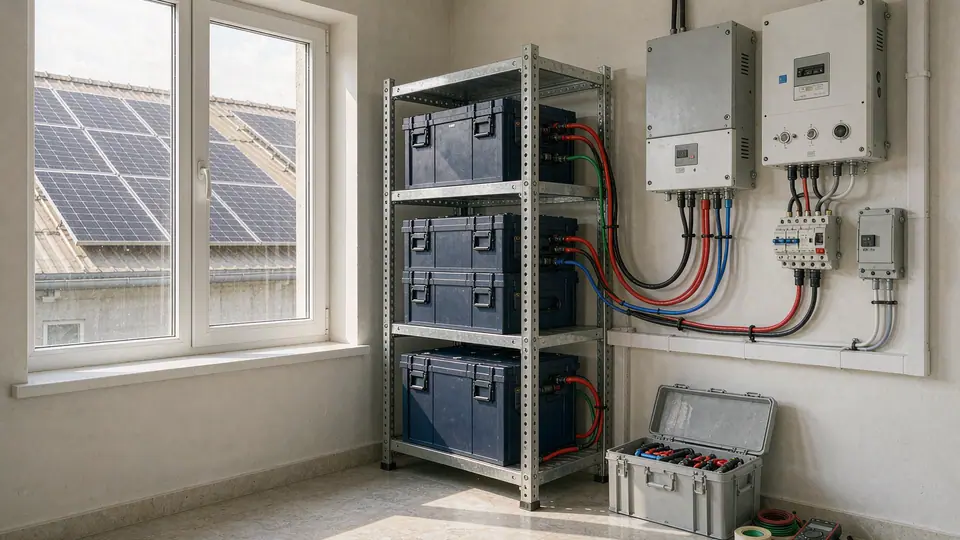
Solar panels get all the glory, but the battery bank decides whether your off-grid system actually works when the sun doesn't. Here is how to size, match and build a LiFePO4 storage system that does its job for a decade.
Start With the Load, Not the Battery
The most common mistake in solar storage: buying panels and batteries by vibe. Start with a week of real numbers instead.
- List every load and its watts (fridge 150W, laptop 65W, LED lighting 30W, water pump 60W, Starlink 75W…)
- Estimate hours per day for each
- Multiply and add: this is your daily Wh (watt-hour) budget
Example cabin day: fridge 1.2kWh + lights 0.3 + pump 0.2 + Starlink 1.8 + laptop 0.3 = ~3.8kWh/day
Translate Wh into Battery Sizing
Now the LiFePO4 advantage shows up in your math. Usable energy:
- Lead-acid bank: usable Wh ≈ rated Wh × 50% (if you want cycles)
- LiFePO4 bank: usable Wh ≈ rated Wh × 90%+
For 3.8kWh/day with one cloudy-day buffer (~7.6kWh usable target):
- Lead-acid: ~15kWh rated (a lot of batteries, a lot of weight)
- LiFePO4: ~8kWh rated — e.g., a 48V (51.2V) 160Ah-class bank, or 2× 25.6V 160Ah in series… or, more practically, a scalable parallel bank
Why Voltage Platform Matters (12V / 24V / 48V)
- 12V (12.8V, 4S): small cabins, vans, weekend systems; cheapest entry
- 24V (25.6V, 8S): mid-size; halves current vs 12V, thinner cables
- 48V (51.2V, 16S): whole-home and serious off-grid; quarter the current of 12V at the same power — dramatically cheaper cabling and lower losses above ~2–3kW inverter loads
Rule of thumb: inverter at or above 3000W → 48V system.
Match the Inverter (and Its Surge)
Your inverter draws hard on the bank — a 3000W inverter at 48V pulls ~62A continuous, but motor starts (fridge compressors, well pumps) demand surge power 2–3× that for seconds. Your battery's spec must cover it:
- Check the battery's continuous discharge rating vs inverter max draw
- Check the peak rating with its time limit (a legitimate spec reads like "500A @ 10s · 1,000A @ 1s") against your biggest surge load
This is the single most common mismatch that causes nuisance shutdowns in DIY systems.
Charging From Solar: What the Battery Needs
- Charge voltage must match the bank: 12V systems charge at 14.6V (4S LFP), 24V at ~29.2V (8S), 48V at 58.4V (16S). Any MPPT solar charge controller with a user-defined LiFePO4 profile handles this — avoid "Lithium" presets you cannot verify
- CC/CV charging: solar controllers deliver constant current in bulk, then hold voltage as the battery tapers — the natural match for LFP
- Charge current: battery spec sheets state a recommended charge current (often ~0.5C); your array's max output should sit at or below it
The Low-Temperature Rule Applies to Solar Too
Off-grid means the battery lives where the weather lives. The BMS will refuse charging below 0°C — which, with a solar charger, is fully automatic and safe. But if your bank charges through sub-zero weather, the practical solution is a self-heating battery (it warms cells using incoming solar power before charging). For indoor battery rooms, standard packs are fine.
Building a Scalable Bank (Parallel Rules)
LiFePO4 12V/24V batteries commonly support parallel connection — e.g., up to 4P, turning one 12V 200Ah into a 12V 800Ah bank. The rules that keep banks healthy:
- Follow the stated limit exactly — series/parallel support is written per model ("4P max, no series" is a spec, not a suggestion)
- Top-charge before paralleling — each battery individually full, so all start at the same voltage
- Same model, same age, same firmware — mixing old and new (or different brands) in parallel unbalances the bank
- For big systems, look for CAN/RS485 communication so the battery talks to the charge controller and inverter — the system then makes decisions based on the battery's actual state (this is how modern Victron-based builds integrate)
Cycle Life Is the Whole Economic Argument
A quality LiFePO4 bank delivers 4,000+ cycles at 80% depth of discharge. Daily-cycled, that is over a decade of service — versus lead-acid banks replaced every 2–4 years. Combined with ~zero maintenance (no watering, no equalizing), the lifetime cost per stored kWh is why every serious off-grid build now specifies LiFePO4.
Pre-Build Checklist
- [ ] Daily Wh budget measured (not guessed)
- [ ] Bank voltage matches inverter size (≥3kW → 48V)
- [ ] Continuous + peak (with time) ratings vs inverter surge
- [ ] MPPT with configurable LiFePO4 profile, set to correct voltage
- [ ] Low-temp cutoff confirmed; self-heating if charging below freezing
- [ ] Parallel limits respected; same-model batteries; top-charged before connecting
- [ ] Storage/maintenance plan: the battery basically needs none — that's the point
Build your bank: Shop 12V / 24V / 48V LiFePO4 storage batteries
Send your load list and inverter model — contact us — and we will check the sizing math with you.