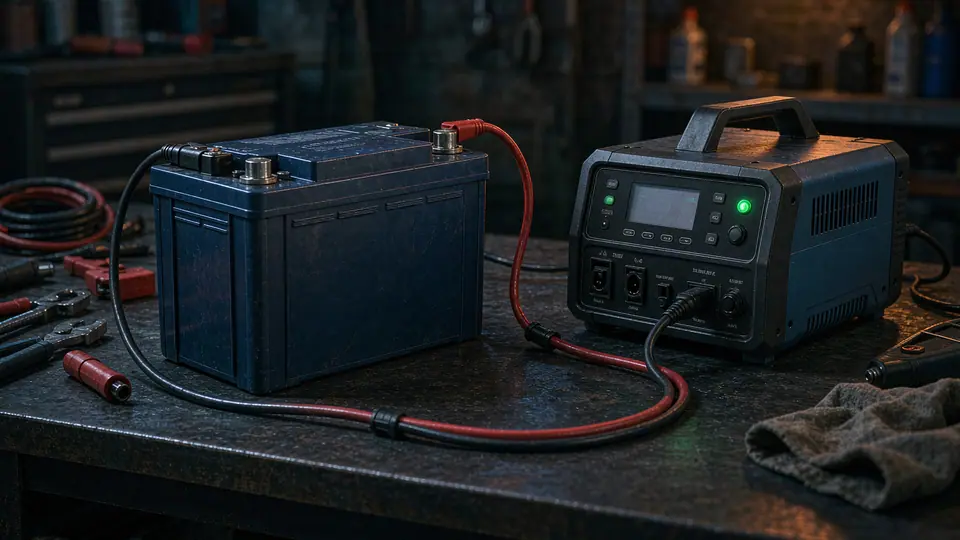
"Can I use my old lead-acid charger on a lithium battery?" It's the #1 charging question we get, and the honest answer is a firm no — use a lithium-specific charger matched to your battery. Here's the science behind why, and the exact voltages your charger should target.
What CC/CV Actually Means
Every lithium battery charges in two phases, controlled between the charger and the BMS:
Phase 1 — CC (Constant Current). The charger holds current steady and voltage rises as the battery fills. This is the fast phase: a 100Ah battery charging at 50A gains about half a full charge per hour here.
Phase 2 — CV (Constant Voltage). When voltage reaches the battery's full-charge point (e.g., 14.6V for a 12.8V LiFePO4 pack), the charger pins the voltage there and lets current taper off naturally. When current drops to a cutoff threshold, the battery is 100% full.
Two properties worth knowing: CC/CV has no float stage (lithium doesn't need one — holding it at full voltage actually ages it), and the CV tail is why real charge times run about 20% longer than "capacity ÷ current" suggests.
The Voltage Table That Matters
Your charger's output must match your battery's platform. For LiFePO4, the industry-standard charge voltages (CC-to-CV transition points) are:
| System | Pack config | Charge voltage (±0.2V) |
|---|---|---|
| 12V | 4S LFP (12.8V) | 14.6V |
| 24V | 8S LFP (25.6V) | 29.2V |
| 36V | 12S LFP (38.4V) | 43.8V |
| 48V | 16S LFP (51.2V) | 58.4V |
Check your battery's spec sheet for its exact number — this table is the typical range, the spec sheet is the law.
Why Lead-Acid Chargers Misfire
Lead-acid and lithium look like they charge similarly. They don't, in three ways that matter:
- Voltage mismatch. A typical 12V lead-acid charger outputs 13.6–14.4V depending on stage. A 12.8V LiFePO4 pack needs 14.6V to fill completely. Result with the wrong charger: the battery never reaches 100% — you've quietly paid for 20% of capacity you never get to use.
- The float stage. Lead-acid chargers hold a float voltage indefinitely to combat self-discharge. Lithium doesn't self-discharge meaningfully and dislikes being held at elevated voltage — long-term float ages cells.
- Desulfation pulses. Many "smart" lead-acid chargers fire high-voltage pulses to break down lead sulfate. Lithium batteries have no sulfate — just a BMS watching voltage limits. Desulfation pulses can repeatedly trip the BMS or stress the pack.
None of this destroys the battery in a day. All of it shortens lifespan and shrinks usable capacity silently over months.
Cold Weather and Charging
One rule overrides everything: never charge lithium below 0°C (32°F) — it causes permanent lithium plating damage. A quality BMS blocks charging below freezing automatically, so a cold-morning "won't charge" is protection, not a fault. Self-heating batteries solve this by warming cells before charging; everyone else should let the battery warm above 0°C first. (Full cold-weather guide: see our winter article.)
Solar Controllers and DC-DC Chargers
The same rules apply beyond wall chargers:
- MPPT solar controllers — must have a configurable LiFePO4 profile (or custom voltage setpoints). Don't trust an unchangeable "Lithium" preset without verifying the voltage.
- DC-DC chargers / B2B — for charging house batteries from a vehicle alternator, use a unit with a lithium profile; older voltage-sensing isolators behave erratically with lithium's flat voltage curve.
Charge Time: Setting Expectations
Approximate charge time ≈ capacity ÷ charge current × 1.2. A 105Ah pack on a 25A charger: 105 ÷ 25 × 1.2 ≈ 5 hours. Faster chargers shorten this until you hit the battery's recommended charge-current limit — the spec sheet's number is the ceiling, not the goal.
The Charging Checklist
- [ ] Charger voltage = battery's stated charge voltage (±0.2V)
- [ ] Charger current ≤ battery's recommended charge current
- [ ] Lithium profile, no float, no desulfation
- [ ] Charging environment inside the battery's charge-temperature window (typically 0–55°C)
- [ ] Solar/alternator sources also on lithium profiles
Get the right charger with your battery: Shop LiFePO4 chargers
Not sure if your existing charger fits? Tell us its model — contact us