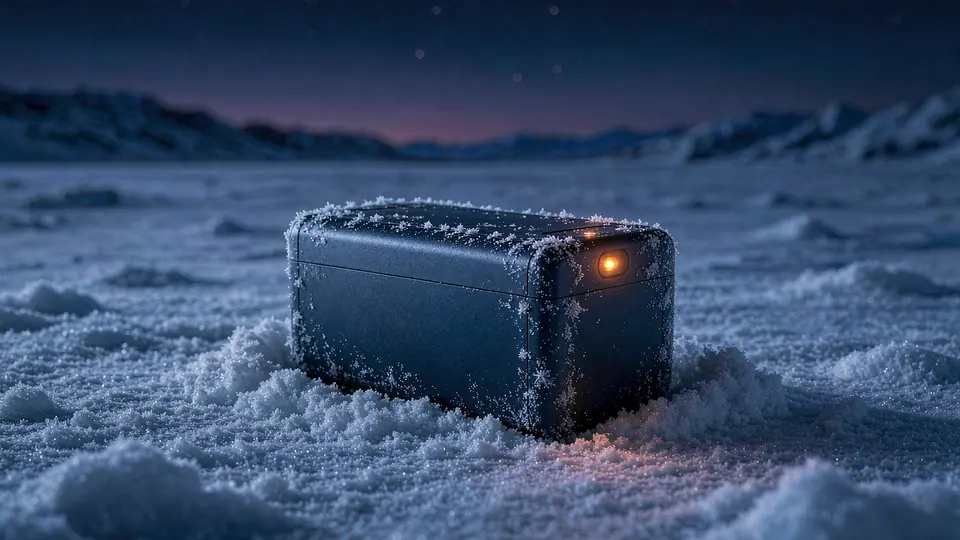
Every winter, the same question floods every battery forum: "My lithium battery won't charge — is it broken?" Almost always, the answer is no. It is doing exactly what it is supposed to do. Here is what is actually happening inside your battery when the temperature drops, and how to get through winter without damage.
The One Rule That Matters Most
Never charge a lithium battery below 0°C (32°F).
This is not a suggestion, and it is not about comfort — it is chemistry. Charging below freezing causes lithium plating: instead of lithium ions intercalating into the anode, metallic lithium deposits on its surface as microscopic needle-like structures. These needles:
- Permanently reduce capacity, every time it happens
- Can grow long enough to pierce the separator between electrodes — creating an internal short-circuit risk
There is no recovering from plating. This is why every quality BMS blocks charging below 0°C automatically — and why a battery that refuses to charge on a cold morning is protecting your investment, not malfunctioning.
The Three Numbers of Cold-Weather Behavior
A well-engineered LiFePO4 battery follows a three-step script, managed by the BMS:
- 0°C (32°F): charging stops. The BMS disconnects the charge circuit while cells are below freezing.
- 5°C (41°F): charging resumes. Cells warm up past the threshold — the BMS re-enables charging automatically.
- -20°C (-4°F): discharging stops. Using power in the cold is much safer than charging, but extreme cold triggers a final protective cutoff.
If you are winter camping or ice fishing, this sequence is written into your battery's spec sheet — check that it is.
Discharging in Cold: Yes, but Budget for It
While charging below freezing is forbidden, discharging is fine down to about -20°C — with a catch: cold temporarily reduces effective capacity. At -10°C to -20°C, expect noticeably less usable energy than the label's 25°C rating. Practical move for winter trips: size your battery with 20–30% margin.
Self-Heating Batteries: Winter's Actual Solution
A self-heating LiFePO4 battery contains heating elements that warm the cells to a safe charging temperature before the charge circuit engages — typically drawing power from the charger itself. The sequence: plug in on a frozen morning → battery heats itself for a while → charging begins once cells pass the threshold. Fully automatic.
Who actually needs self-heating:
- Ice fishing anglers — the battery lives in a sled or shuttle on frozen lakes
- Four-season RVers — winter boondocking below freezing
- Cold-climate off-grid cabins — solar charging through sub-zero days
Who doesn't: anyone storing or using the battery indoors at room temperature. For warm-climate use, it is paying for a winter coat in summer.
Winter Storage: Four Steps
Storing a golf cart, boat, RV or scooter for the season?
- Store at ~50% state of charge. Not full, not empty — mid-charge is the least stressful resting state for lithium.
- Store in a dry spot above -10°C (14°F). A garage that stays above freezing is ideal; the battery's storage temperature range will be stated on its spec sheet.
- Disconnect everything. Kill switches, disconnects, loads — small parasitic drains are how stored batteries arrive dead in spring.
- Top up every three months. Check the charge level each quarter and bring it back to ~50% if it has drifted down.
That's the entire ritual. No watering, no equalization charge, no trickle charger babysitting — that is the lead-acid life you left behind.
Winter Charging Done Right
- Always charge at temperatures inside the battery's stated charging window (typically 0°C–55°C / 32°F–131°F)
- If the battery has been outside in the cold, let it warm up before charging — the BMS will make its own decision, but a room-temperature battery charges faster and happier
- Use only the matched lithium charger for your battery's voltage and chemistry — in winter, mismatched chargers do their worst damage fastest
- For vehicles kept plugged in outdoors in cold climates: self-heating (again) solves this completely
Common Winter Questions
"My battery shows charge but won't take current." Cold cells plus a protective BMS. Warm it up first.
"Can I bring it inside to charge?" Yes — charging a cold-soaked battery after letting it reach room temperature is standard practice and completely safe.
"Does cold permanently damage lithium even if I don't charge it?" Storage cold (above -10°C, at partial charge) is safe. The damage scenario is charging while frozen — that's it.
"What about my old lead-acid winter habits?" Unlearn them. No trickle maintenance all winter, no full-charge storage requirement. Lithium wants partial charge and sleep.
The Winter-Ready Summary
| Situation | What to do |
|---|---|
| Charging below 0°C | Don't — the BMS blocks it; warm the battery first |
| Using power in cold | Fine down to about -20°C, budget ~25% extra capacity |
| Hard-freeze climate, active use | Buy self-heating |
| Seasonal storage | 50% charge, dry, above -10°C, disconnect, quarterly top-up |
| Charger | Matched lithium charger only |
Winter-proof your setup: Shop self-heating LiFePO4 batteries
Not sure if your climate needs self-heating? Tell us where and how you use it