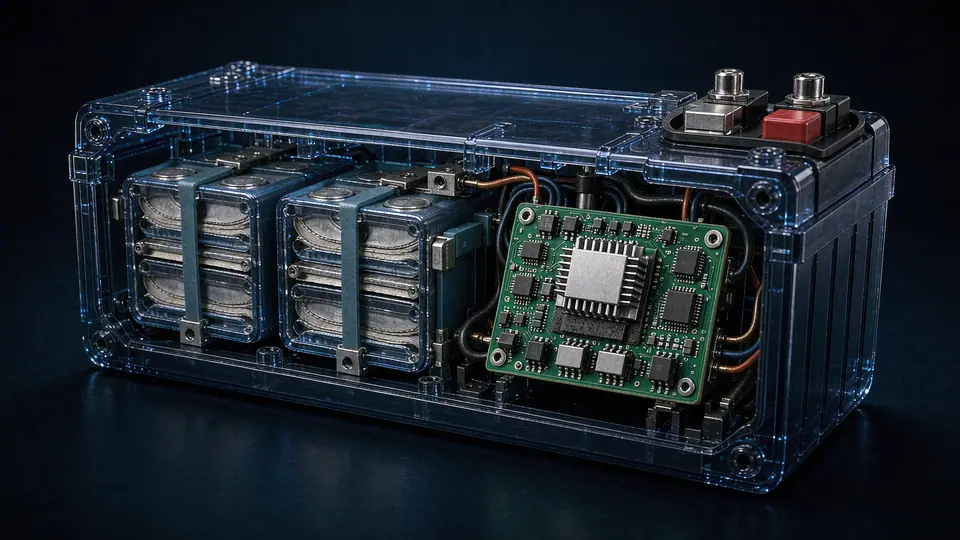
Every lithium battery you have ever used — phone, scooter, RV battery — has a hidden component that decides whether it lives five years or five months. It is called the BMS: Battery Management System. If you are shopping for any LiFePO4 battery, understanding the BMS is how you tell a quality pack from a gamble.
What a BMS Actually Does
A lithium cell is powerful but intolerant of abuse. Charge it too far, drain it too far, pull too much current, charge it below freezing, or short it out — and it degrades or becomes dangerous. The BMS is a circuit board sitting between the cells and the outside world, watching every one of those conditions and cutting power before damage happens.
Its core jobs:
- Over-charge protection — stops charging when a cell hits its upper voltage limit
- Over-discharge protection — disconnects the load before cells drain to a damaging level
- Over-current protection — enforces the battery's continuous and peak current limits
- Short-circuit protection — instant disconnect on a dead short
- Temperature protection — enforces the full thermal window: blocks charging below 0°C / 32°F and above roughly 45°C / 113°F, limits discharge in extreme heat (typically ≥60°C / 140°F cutoff), and keeps the pack inside a safe storage window. Cold gets the headlines, but heat ages lithium just as fast.
Protection is only half the job. The other half is measurement: the BMS reads every cell's voltage many times per second and tracks current in and out (a technique called coulomb counting). From that it computes the state of charge (SOC) and state of health (SOH) numbers you see on spec sheets and in apps. Every feature below is built on top of that measurement layer.
When a battery "shuts off" under heavy load and comes back minutes later — that is the BMS doing over-temperature or over-current management, not a defect.
Reading a BMS Spec Sheet Like a Pro
Here is the vocabulary, and what each line really means:
Continuous vs Peak Current
- Continuous current: what the battery can supply indefinitely. A 1,000W inverter on 12V pulls roughly 100A after conversion losses — so a "100A BMS" runs it at the edge, not with room to spare. Size the BMS 20–30% above your real load.
- Peak current: the short burst allowed for motor starts and surges — always with a time limit (e.g., "500A @ 10s · 1,000A @ 1s"). A peak number without a time is a red flag; every legitimate rating pairs the two.
The Low-Temperature Rules (Memorize These)
Three numbers define cold behavior on a well-documented battery:
- 0°C (32°F) — charging stops. Charging lithium below freezing causes lithium plating: microscopic metal needles that permanently damage the cell and can create internal shorts. A quality BMS blocks charging automatically.
- 5°C (41°F) — charging resumes. The BMS re-enables charging once cells warm back above the threshold.
- -20°C (-4°F) — discharge stops. Discharging in cold is far less harmful, but extreme cold triggers a protective cutoff.
Self-Heating: The Upgrade That Changes Winter
A self-heating battery contains heating elements that warm the cells to a safe charging temperature using charge power. If you run an RV, boat, or ice-fishing setup through real winters, this feature converts "battery unusable December–February" into "battery works all year."
TVS: Surge Protection for Motor Loads
Motors (trolling motors, winches, cart controllers) kick voltage spikes backward when they stop or reverse. TVS (transient voltage suppression) is the circuitry that absorbs those spikes so they do not punch through the BMS. Running motors off a battery without TVS-rated protection is how packs die young.
Balancing: Keeping Every Cell Even
Cells in series drift apart slightly with every cycle. The BMS corrects this:
- Passive balancing (standard): burns off a little energy from the highest cells until others catch up
- Active balancing (premium): moves energy from high cells to low cells — more efficient, keeps large banks healthier over years
Unbalanced packs lose usable capacity and age unevenly — protection keeps a battery safe, but balancing is what keeps it honest over the years.
Bluetooth Monitoring
A BMS with Bluetooth broadcasts state of charge, voltage, current, temperature and cycle count to an app. Once you have watched your house bank's SOC from the couch, you never go back.
OTA: Firmware Upgrades
Over-the-air updates let the manufacturer improve BMS behavior (cutoff thresholds, balancing logic) after purchase. A battery that can improve with age is a genuinely new thing.
CAN / RS485 Communication
For RV solar systems and energy racks, the BMS can talk to external equipment — a Victron Cerbo GX, all-in-one inverters, battery shunts — so the whole system sees the battery's true state. If you are building an integrated power system, look for this.
CCA / Dual Purpose
Starter batteries need cold cranking amps — a burst-current standard for engine starting. A dual purpose LiFePO4 battery carries a CCA rating and can both crank an engine and serve as a deep-cycle house battery. A standard deep-cycle pack must never be used to start an engine, no matter its size — that is what the CCA rating (or its absence) is telling you.
What Else Modern BMS Boards Do
The features above are the ones most product pages talk about. But a well-engineered board in 2026 does more — and these quieter features often separate a five-year pack from a five-month one:
- Pre-charge / anti-spark hookup. A large inverter's input capacitors look like a dead short for a few milliseconds when you first connect it — enough to trip protection or pit the connector. Better boards include a pre-charge path that eases the connection in. If a pack "clicks" or trips its protection every time you hook up an inverter, this is the missing feature.
- Sleep mode & low standby drain. The BMS itself sips power around the clock. Over weeks of storage, that sip becomes the thing that flattens your battery. Quality boards drop to microamp-level standby after days of inactivity (or on command from the app) and wake automatically when a charger is connected — exactly what you want in an RV or boat that sits all winter.
- Layered hardware protection. A cutoff circuit can itself fail, so good boards stack defenses: the main cutoff FETs, plus a fuse, plus TVS — and on better designs an independent secondary protection IC that still acts if the main controller glitches. Defense in depth, not a single line in the sand.
- Moisture & corrosion defense. A conformal-coated circuit board (lacquer-sealed against humidity) and a sealed enclosure — IP65 to IP67 — keep salt air and condensation from eating the electronics. Non-negotiable for marine and coastal use.
- Fault log & event history. Smart BMS boards record protection events with timestamps — over-current at 2:14 PM, low-voltage cutoff at 2:15 PM. When something "randomly" shuts down, the log tells you whether to blame the load, the charger, or the battery, and support can diagnose it without guesswork.
- Predictable recovery behavior. Some protections auto-reset once the fault clears; others latch off until a charger wakes the pack. Both are valid designs — a well-documented battery simply says which is which, so you are never stranded guessing.
Why "One BMS Fits All" Is Never True
A 4S 12V battery and a 16S 48V battery need different BMS boards with different voltage windows. Replacement BMS boards are matched by series count, continuous current, and features — parameters that must match the pack exactly. This is also why BMS specs belong on the product page: they are the honest fingerprint of the battery.
The Buyer's BMS Checklist
- [ ] Continuous current rated 20–30% above your real load (inverters pull more than their label says)
- [ ] Peak current with time limit stated
- [ ] Full temperature window stated — charge / discharge / storage, not just "0°C cutoff"
- [ ] Low-temperature charge cutoff (0°C) — non-negotiable
- [ ] TVS / surge rating if you run motors
- [ ] Pre-charge or anti-spark design if you connect a large inverter
- [ ] Balancing (active preferred for large banks)
- [ ] Bluetooth if you like knowing instead of guessing
- [ ] Self-heating if you use the battery in freezing conditions
- [ ] CAN/RS485 if you are integrating with an energy system
- [ ] Low standby drain if the battery sits unused for weeks
Every CBJJ battery lists its complete BMS feature set — checked item by item, never assumed. Browse batteries
Questions about a specific BMS feature? Ask us