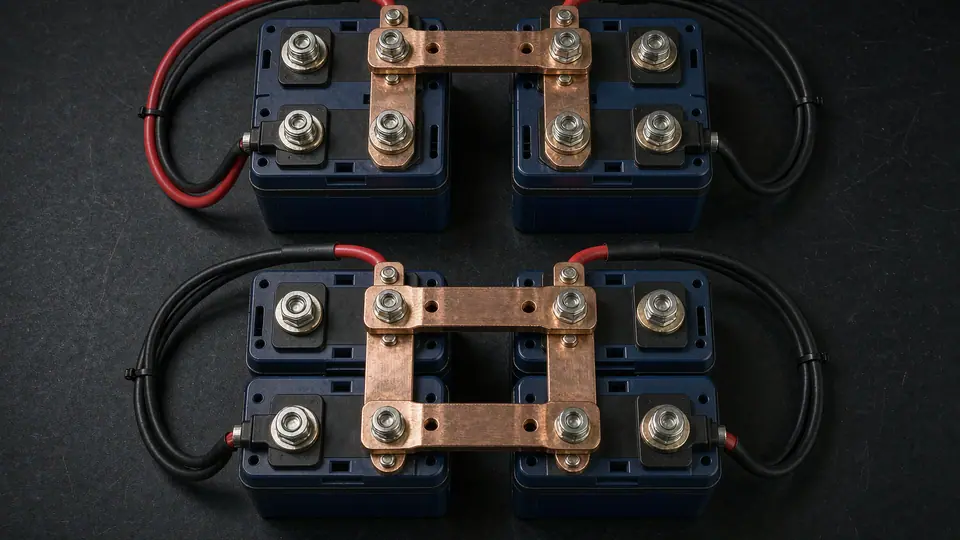
Somewhere on every battery spec sheet is a cryptic string like 12S1P or 4S2P. It's the battery's configuration code — the single most information-dense field on the whole sheet. Here's how to read it, and the rules for connecting multiple batteries without wrecking them.
S and P: The Two Dials
Every battery pack is built from individual cells (LiFePO4 cells are 3.2V each). Two ways to wire them:
Series (S): positive to negative. Voltages add up. 4 LiFePO4 cells in series = 12.8V. Series determines the pack's voltage.
Parallel (P): positive to positive, negative to negative. Capacities add up. Two 100Ah strings in parallel = 200Ah at the same voltage. Parallel determines the pack's capacity.
Reading the Code
12S1P = 12 cells in series, 1 string in parallel:
- Voltage: 12 × 3.2V = 38.4V (the golf-cart standard for "36V" carts)
- Capacity: that of one cell string (e.g., 105Ah)
4S2P = 4 cells in series, 2 strings in parallel:
- Voltage: 4 × 3.2V = 12.8V (a "12V" battery)
- Capacity: 2 × cell Ah (e.g., 2 × 100Ah = 200Ah)
So from one code you know the pack's exact voltage and how its capacity is built. This is why honest spec sheets always state configuration — it also lets you verify the battery matches its claimed numbers.
The Voltage Ladder (Memorize These Four)
| Platform | LiFePO4 configuration | Nominal | Fully charged |
|---|---|---|---|
| 12V | 4S | 12.8V | 14.6V |
| 24V | 8S | 25.6V | 29.2V |
| 36V | 12S | 38.4V | 43.8V |
| 48V | 16S | 51.2V | 58.4V |
Connecting Finished Batteries: The Rules
Building a bigger bank from finished packs is where people get hurt (or get smoke). The rules, in order of how often they're violated:
Rule 1: Follow the Stated Limit — Exactly
Manufacturers test and warrant specific connection limits: "supports up to 4 in parallel, no series" is a hard engineering statement. The BMS, internal wiring and balancing are designed around it. If the spec doesn't say it, assume it's not supported — never guess.
Rule 2: Top-Charge Before Paralleling
Before connecting packs in parallel, fully charge each one individually. If you connect a full pack (14.6V) to a half-empty one (13.4V), the full pack dumps current into the other with nothing but wire resistance limiting it — potentially hundreds of amps, tripping or damaging the BMS. Same voltage first, then connect.
Rule 3: Match Like to Like
Same model, same capacity, same age (and ideally same firmware). Mixing a 100Ah and a 200Ah pack in parallel means they drain and charge unevenly; mixing old and new means the weak one drags the strong one.
Rule 4: Series Is the Dangerous One
Series connections raise voltage and expose BMS designs to conditions they may not be rated for — many 12V LiFePO4 batteries explicitly prohibit series. Golf carts at 48V should use a purpose-built 16S (51.2V) pack, not four 12V batteries in series, unless each battery explicitly permits it.
Rule 5: One Chemistry, One System
Never mix lead-acid and lithium in the same string or bank. Different voltages, different charge profiles, different behaviors — guaranteed damage to at least one of them.
Why Parallel Banks Beat Single Giant Packs (Sometimes)
Advantages of a parallel bank: scalability (start with 200Ah, add another later), redundancy (one pack fails, the rest carry on), and handling (two 60-lb packs beat one 120-lb monster for install day). The cost: more cables, more connection points, and the need to follow the rules above. For most RV and off-grid builds, a 2–4P bank of identical packs is the sweet spot.
Quick Reference
| You want | You wire | Voltage | Capacity |
|---|---|---|---|
| Higher voltage | Series | Adds | Same |
| More capacity | Parallel | Same | Adds |
| Both | Series-parallel (matched strings) | Adds | Adds |
Building a bank? Shop LiFePO4 batteries with stated series/parallel limits
Tell us your target voltage and total capacity — contact us — and we'll map the wiring for you.